Ash Wednesday marks the beginning of the Lent which lasts for 40 days of prayer and fasting. Many Christians, especially Catholics, observe the day by going to church to receive ashes prepared from the blessed palms used during the previous year’s Palm Sunday. The priest makes the sign of the cross on our foreheads with the ashes and says “Dust thou art, and into dust thou shalt return.” This expression tells me that I’m on earth as a favor from God, and that I should use my time wisely.
My mother was a devout Catholic. She went to church frequently, and observed holy days of obligation, including Ash Wednesday. On this blessed day, my sister and I would go to church with Mom to receive the ashes.
This holy day reminds me of the special times that I spent with my family, and it particularly reminds me that Jesus Christ suffered and died on the cross to save mankind.
Dear readers, I sincerely thank PBS for providing the following information:
Ten Little Known Black History Facts
History is often reduced to a handful of memorable moments and events. In Black history, those events often include courageous stories like those of The Underground Railroad and historic moments like the famous “I Have a Dream” speech by Dr. Martin Luther King, Jr. But these are only a few of the significant and important events to know and remember.
In an effort to honor this expansive and growing history, Black History Month was established by way of a weekly celebration in February known as “Negro History Week” by historian Carter G. Woodson. But just as Black history is more than a month, so too are the numerous events and figures that are often overlooked during it. What follows is a list of some of those “lesser known” moments and facts in Black history.
Before there was Rosa Parks, there was Claudette Colvin.
Most people think of Rosa Parks as the first person to refuse to give up their seat on a bus in Montgomery, Alabama. There were actually several women who came before her; one of whom was Claudette Colvin.
It was March 2, 1955, when the fifteen-year-old schoolgirl refused to move to the back of the bus, nine months before Rosa Parks’ stand that launched the Montgomery bus boycott. Claudette had been studying Black leaders like Harriet Tubman in her segregated school, those conversations had led to discussions around the current day Jim Crow laws they were all experiencing. When the bus driver ordered Claudette to get up, she refused, “It felt like Sojourner Truth was on one side pushing me down, and Harriet Tubman was on the other side of me pushing me down. I couldn’t get up.”
Claudette Colvin’s stand didn’t stop there. Arrested and thrown in jail, she was one of four women who challenged the segregation law in court. IfBrowder v. Gayle became the court case that successfully overturned bus segregation laws in both Montgomery and Alabama, why has Claudette’s story been largely forgotten? At the time, the NAACP and other Black organizations felt Rosa Parks made a better icon for the movement than a teenager. As an adult with the right look, Rosa Parks was also the secretary of the NAACP, and was both well-known and respected – people would associate her with the middle class and that would attract support for the cause. But the struggle to end segregation was often fought by young people, more than half of which were women.
Martin Luther King Jr. improvised the most iconic part of his “I Have a Dream Speech.”
On Wednesday, August 28, 1963, 250,000 Americans united at the Lincoln Memorial for the final speech of the March on Washington. As Martin Luther King Jr. stood at the podium, he eventually pushed his notes aside.
The night before the march, Dr. King began working on his speech with a small group of advisers in the lobby of the Willard Hotel. The original speech was more political and less historic, according to Clarence B. Jones, and it did not include any reference to dreams. After delivering the now famous line, “we are not satisfied, and we will not be satisfied until justice rolls down like waters and righteousness like a mighty stream,” Dr. King transformed his speech into a sermon.
Onstage near Dr. King, singer Mahalia Jackson reportedly kept saying, “Tell ‘em about the dream, Martin,” and while no one will know if he heard her, it could likely have been the inspiration he needed. Dr. King then continued, “Even though we face the difficulties of today and tomorrow, I still have a dream. It is a dream deeply rooted in the American dream….” And then the famous Baptist preacher preached on, adding repetition and outlining the specifics of his dream. And while this improvised speech given on that hot August day in 1963 was not considered a universal success immediately, it is now recognized as one of the greatest speeches in American history. For more information on the 1963 March on Washington, visit pbs.org/marchonwashington.
Image: National Archives and Records Administration
Inoculation was introduced to America by a slave.
Few details are known about the birth of Onesimus, but it is assumed he was born in Africa in the late seventeenth century before eventually landing in Boston. One of a thousand people of African descent living in the Massachusetts colony, Onesimus was a gift to the Puritan church minister Cotton Mather from his congregation in 1706.
Onesimus told Mather about the centuries old tradition of inoculation practiced in Africa. By extracting the material from an infected person and scratching it into the skin of an uninfected person, you could deliberately introduce smallpox to the healthy individual making them immune. Considered extremely dangerous at the time, Cotton Mather convinced Dr. Zabdiel Boylston to experiment with the procedure when a smallpox epidemic hit Boston in 1721 and over 240 people were inoculated. Opposed politically, religiously and medically in the United States and abroad, public reaction to the experiment put Mather and Boylston’s lives in danger despite records indicating that only 2% of patients requesting inoculation died compared to the 15% of people not inoculated who contracted smallpox.
Onesimus’ traditional African practice was used to inoculate American soldiers during the Revolutionary War and introduced the concept of inoculation to the United States.
The earliest recorded protest against slavery was by the Quakers in 1688.
Quakers, also known as “The Society of Friends,” have a long history of abolition. But it was four Pennsylvania Friends from Germantown who wrote the initial protest in the 17th century. They saw the slave trade as a grave injustice against their fellow man and used the Golden Rule to argue against such inhumane treatment; regardless of skin color, “we should do unto others as we would have done onto ourselves.” In their protest they stated, “Pray, what thing in the world can be done worse towards us, then if men should robb or steal us away, & sell us for slaves to strange Countries, separating housband from their wife and children….”
Their protest against slavery and human trafficking was presented at a “Monthly Meeting at Dublin” in Philadelphia. The Dublin Monthly Meeting reviewed the protest but sent it to the Quarterly Meeting, feeling it to be too serious an issue for their own meeting to decide. The four Friends continued their efforts and presented at the Philadelphia Yearly Meeting, but it wasn’t until 88 years later that the Society of Friends officially denounced slavery.
Over the centuries, this rare document has been considered lost twice. Most recently it was rediscovered in 2005 and is now at Haverford College Special Collections.
Photo: 1688 Germantown Quaker Petition Against Slavery
Of the 12.5 million Africans shipped to the New World during the Transatlantic Slave Trade, fewer than 388,000 arrived in the United States.
In the late 15th century, the advancement of seafaring technologies created a new Atlantic that would change the world forever. As ships began connecting West Africa with Europe and the Americas, new fortunes were sought and native populations were decimated. With the native labor force dwindling and demand for plantation and mining labor growing, the transatlantic slave trade began.
The Transatlantic Slave Trade was underway from 1500-1866, shipping more than 12 million African slaves across the world. Of those slaves, only 10.7 million survived the dreaded Middle Passage. Over 400 years, the majority of slaves (4.9 million) found their way to Brazil where they suffered incredibly high mortality rates due to terrible working conditions. Brazil was also the last country to ban slavery in 1888.
By the time the United States became involved in the slave trade, it had been underway for two hundred years. The majority of its 388,000 slaves arrived between 1700 and 1866, representing a much smaller percentage than most Americans realize.
Image:African Renaissance Monument, Senegal
The diverse history of Historically Black Colleges and Universities.
While Jewish and African American communities have a tumultuous shared history when it comes to the pursuit of civil rights, there is a chapter that is often overlooked. In the 1930s when Jewish academics from Germany and Austria were dismissed from their teaching positions, many came to the United States looking for jobs. Due to the Depression, xenophobia and rising anti-Semitism, many found it difficult to find work, but more than 50 found positions at HBCUs in the segregated South.
Originally established to educate freed slaves to read and write, the first of the Historically Black Colleges and Universities was Cheyney University in Pennsylvania, established in 1837. By the time Jewish professors arrived, the number of HBCUs had grown to 78. At a time when both Jews and African Americans were persecuted, Jewish professors in the Black colleges found the environment comfortable and accepting, often creating special programs to provide opportunities to engage Blacks and whites in meaningful conversation, often for the first time.
In the years that followed, the interests of Jewish and African American communities increasingly diverged, but this once-shared experience of discrimination and interracial cooperation remains a key part of the Civil Rights Movement.
Image: Melrose Cottage, built in 1805, Cheyney University of Pennsylvania.
One in four cowboys was Black, despite the stories told in popular books and movies.
In fact, it’s believed that the real “Lone Ranger” was inspired by an African American man named Bass Reeves. Reeves had been born a slave but escaped West during the Civil War where he lived in what was then known as Indian Territory. He eventually became a Deputy U.S. Marshal, was a master of disguise, an expert marksman, had a Native American companion, and rode a silver horse. His story was not unique however.
In the 19th century, the Wild West drew enslaved Blacks with the hope of freedom and wages. When the Civil War ended, freedmen came West with the hope of a better life where the demand for skilled labor was high. These African Americans made up at least a quarter of the legendary cowboys who lived dangerous lives facing weather, rattlesnakes, and outlaws while they slept under the stars driving cattle herds to market.
While there was little formal segregation in frontier towns and a great deal of personal freedom, Black cowboys were often expected to do more of the work and the roughest jobs compared to their white counterparts. Loyalty did develop between the cowboys on a drive, but the Black cowboys were typically responsible for breaking the horses and being the first ones to cross flooded streams during cattle drives. In fact, it is believed that the term “cowboy” originated as a derogatory term used to describe Black “cowhands.”
Image: Bass Reeves, The first African-American US Deputy Marshal
Esther Jones was the real Betty Boop
The iconic cartoon character Betty Boop was inspired by a Black jazz singer in Harlem. Introduced by cartoonist Max Fleischer in 1930, the caricature of the jazz age flapper was the first and most famous sex symbol in animation. Betty Boop is best known for her revealing dress, curvaceous figure, and signature vocals “Boop Oop A Doop!” While there has been controversy over the years, the inspiration has been traced back to Esther Jones who was known as “Baby Esther” and performed regularly in the Cotton Club during the 1920s.
Baby Esther’s trademark vocal style of using “boops” and other childlike scat sounds attracted the attention of actress Helen Kane during a performance in the late 1920s. After seeing Baby Esther, Helen Kane adopted her style and began using “boops” in her songs as well. Finding fame early on, Helen Kane often included this “baby style” into her music. When Betty Boop was introduced, Kane promptly sued Fleischer and Paramount Publix Corporation stating they were using her image and style. However video evidence came to light of Baby Esther performing in a nightclub and the courts ruled against Helen Kane stating she did not have exclusive rights to the “booping” style or image, and that the style, in fact, pre-dated her.
Baby Esther’s “baby style” did little to bring her mainstream fame and she died in relative obscurity but a piece of her lives on in the iconic character Betty Boop.
Image: Esther Jones (“Baby Esther”), late 1920s by James VanDerZee
The first licensed African American Female pilot was named Bessie Coleman.
Born in Atlanta, Texas in 1892, Bessie Coleman grew up in a world of harsh poverty, discrimination and segregation. She moved to Chicago at 23 to seek her fortune, but found little opportunity there as well. Wild tales of flying exploits from returning WWI soldiers first inspired her to explore aviation, but she faced a double stigma in that dream being both African American and a woman.
She set her sights on France in order to reach her dreams and began studying French. In 1920, Coleman crossed the ocean with all of her savings and the financial support of Robert Abbott, one of the first African American millionaires. Over the next seven months, she learned to fly and in June of 1921, the Fédération Aéronautique Internationale awarded her an international pilot’s license. Wildly celebrated upon her return to the United States, reporters turned out in droves to greet her.
Coleman performed at numerous airshows over the next five years, performing heart thrilling stunts, encouraging other African Americans to pursue flying, and refusing to perform where Blacks were not admitted. When she tragically died in a plane accident in 1926, famous writer and equal rights advocate Ida B. Wells presided over her funeral. An editorial in the “Dallas Express” stated, “There is reason to believe that the general public did not completely sense the size of her contribution to the achievements of the race as such.”
Image: Bessie Coleman and her plane in 1922, Monash University
Interracial marriage in the United Sates was banned in 1664 and not overturned until 1967.
During the seventeenth and early eighteenth century, the growing number of interracial marriages (also known as miscegenation) between Blacks and whites led to the passage of this new law. The first anti-miscegenation law enacted was in the colony of Maryland in 1664 and additional colonies quickly followed suit. These marriages were prohibited and penalties included the enslavement, exile or imprisonment of the white perpetrators. These laws grew and evolved over the years and attempts were even made to modify the Constitution to ban interracial marriage in all states.
It would take three hundred years for this law to be overturned. In 1967, Richard Loving, a white man, and Mildred Jeter, a Black woman, were married in the District of Columbia. When they returned home to Virginia, they were arrested and convicted of violating the state’s anti-miscegenation law. They each faced a year in jail and their case went to the Supreme Court. The Supreme Court found in favor of the Lovings in the famous trial Loving v. Virginia. They ruled that prohibiting interracial marriage on state and local levels was unconstitutional; this meant that marriages between the races were legal in the country for the first time since 1664.
In 2000, Alabama became the last state to officially legalize interracial marriage by removing the unenforceable ban that was still contained in their state constitution. Read more famous cases about interracial relationships that changed history.
I have two adorable pets, a cat, Marty, and a foxhound, Twister. We love them!
Marty is probably 14 years old. He used to be a feral cat, but we turned him and his brother, Klyban, and their mother into indoor cats. Klyban and Marty were very fond of each other, almost inseparable. They played, and when they rested, slept together.
Marty and Klyban sleeping together
Mamma Kitty
Klyban playing inside a cardboard box
One morning, about 3 years ago, Mamma Kitty suddenly vomited blood. My husband rushed her to our vet, but he called me to give me the sad news: ” Mamma didn’t make it.” We miss her a lot. She was an amazing cat, who loved to play with her toys. Many times we heard her meowing to them as if they were her children.
Unfortunately, last year we lost Klyban to lymphoma on June 26, 2019. Losing him hit me and my husband very hard. I’m sure that his death affected Marty, also. Marty was not himself for several months, and I realized that this behavior was probably due to missing Klyban. I can understand how Marty must have felt. I cried rivers when Klyban passed away and found it very hard to not see him sleeping on my bed, on the recliner, and sofa; walking around the house; and playing with Marty. For several months, every time I thought about him, tears flowed from my eyes because I no longer had him. ( I experienced the same feelings when Mamma died, but at least she didn’t suffer from undergoing cancer treatments.)
My husband and I spend as much time as possible with Marty after Klyban’s passing because we understood that there was a possibility that he was still grieving. It wasn’t until recently, perhaps this past month, that Marty started to act like himself. He sleeps and has become very affectionate. This behavior probably means he has accepted the loss of his sibling. (I’m not done with losing Klyban or Mamma; however, Marty and my husband keep me happy, and so does our foxhound, Twister.
Twister
Twister is a rescue dog. When we found him in our backyard, he was very sick. We took him to our vet and learned he had steroid responsive meningitis. Twister underwent treatments and survived, and now he’s been part of the family for approximately 11 years.
My final comment or recommendation on National Pet Day is to love and take good care of your pets. They love you unconditionally and make your life merrier when it hits a rough spot.
Dear Readers, I thought you might enjoy reading the following article about Valentine’s day.
History of St. Valentine
FR. WILLIAM SAUNDERS
Who was Saint Valentine and how did he come to inspire Valentine’s Day?
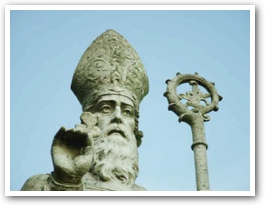
St. Valentine
In the early martyrologies, three different St. Valentines are mentioned, all sharing Feb. 14 for a feast day. Unfortunately, the historical record is sparse. The first St. Valentine was a priest and physician in Rome. He along with St. Marius and his family comforted the martyrs during the persecution of Emperor Claudius II, the Goth. Eventually, St. Valentine was also arrested, condemned to death for his faith, beaten with clubs, and finally beheaded on Feb. 14, AD 270. He was buried on the Flaminian Way. Later, Pope Julius I (333-356) built a basilica at the site which preserved St. Valentine’s tomb. Archeological digs in the 1500s and 1800s have found evidence of the tomb of St. Valentine. However, in the thirteenth century, his relics were transferred to the Church of Saint Praxedes near the Basilica of St. Mary Major, where they remain today. Also, a small church was built near the Flaminian Gate of Rome which is now known as the Porta del Popolo but was called in the 12th century “the Gate of St. Valentine,” as noted by the early British historian William Somerset (also known as William of Malmesbury, d. 1143), who ranks after St. Bede in authority.
The second St. Valentine was the Bishop of Interamna (now Terni, located about 60 miles from Rome). Under the orders of Prefect Placidus, he too was arrested, scourged, and decapitated, again suffering persecution during the time of Emperor Claudius II.
The third St. Valentine suffered martyrdom in Africa with several companions. However, nothing further is known about this saint. In all, these men, each named St. Valentine, showed heroic love for the Lord and His Church.
The popular customs of showing love and affection on St. Valentine’s Day is almost a coincidence with the feast day of the saint: During the Medieval Age, a common belief in England and France was that birds began to pair on Feb.14, “half-way through the second month of the year.” Chaucer wrote in his “Parliament of Foules” (in Old English): “For this was on Seynt Valentyne’s day, When every foul cometh ther to choose his mate.” For this reason, the day was dedicated to “lovers” and prompted the sending of letters, gifts, or other signs of affection.
Another literary example of St. Valentine’s Day remembrances is found in Dame Elizabeth Brews “Paston Letters” (1477), where she writes to the suitor, John Paston, of her daughter, Margery: “And, cousin mine, upon Monday is St. Valentine’s day and every bird chooseth himself a mate, and if it like you to come on Thursday night, and make provision that you may abide till then, I trust to God that ye shall speak to my husband and I shall pray that we may bring the matter to a conclusion.” In turn, Margery wrote to John: “Unto my right well beloved Valentine John Paston, Squyer, be this bill delivered. Right reverend and worshipful and my right well beloved Valentine, I recommend me unto you, full heartily desiring to hear of your welfare, which I beseech Almighty God long for to preserve until His pleasure and your heart’s desire.” While speaking of the amorous flavor of Valentine’s Day, no mention is made of the saint.
While it seems that the exchange of “valentines” is more the result of secular custom rather than the memory of St. Valentine, and that the celebration has been further paganized with cupids and the like, there is a Christian message that should be remembered. The love of our Lord, depicted beautifully in the image of His most Sacred Heart, is a sacrificial, self-less, and unconditional love. Such is the love that each Christian is called to express in his own life, for God and neighbor. Clearly, St. Valentine no matter which one showed such a love, bearing witness to the faith in his dedication as a priest and in the offering of his own life in martyrdom. On this Valentine’s day, looking to the example of this great saint, each person should offer again his love to the Lord, for only by doing so can he properly love those who are entrusted to his care and any other neighbor. Each person should again pledge his love to those loved ones, praying for their intentions, promising fidelity to them, and thanking them for their love in return. Never forget Jesus said, “This is my commandment: love one another as I have loved you. There is no greater love than this: to lay down one’s life for one’s friends” (Jn 15:12-13). St. Valentine fulfilled this command, and may we do the same.
Acknowledgement
Saunders, Rev. William. “History of Saint Valentine.” Arlington Catholic Herald.
This article is reprinted with permission from Arlington Catholic Herald.








 Father William Saunders is pastor of Our Lady of Hope parish in Potomac Falls, Virginia. He is dean of the Notre Dame Graduate School of Christendom College. The above article is a “Straight Answers” column he wrote for the Arlington Catholic Herald. Father Saunders is the author of
  M. E. Murray
You must be logged in to post a comment.